
MiRack
This week I have been having some serious fun with modular synths again

Have you ever wanted to get into Modular synthesis? If you’ve not come across this term before, let me show you some scary examples, that will melt your mind as much as they did mine…
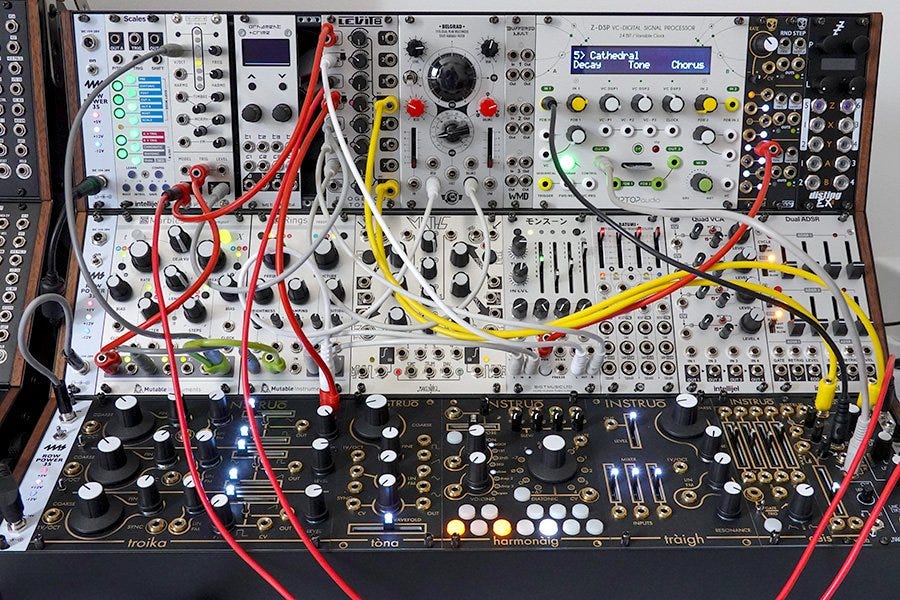
Courtesy of https://www.michael-letchford.com/video-blog/eurorack-modular-synthesis-and-sound-therapy
This is actually a fairly modest one, how about Hans Zimmer’s setup?
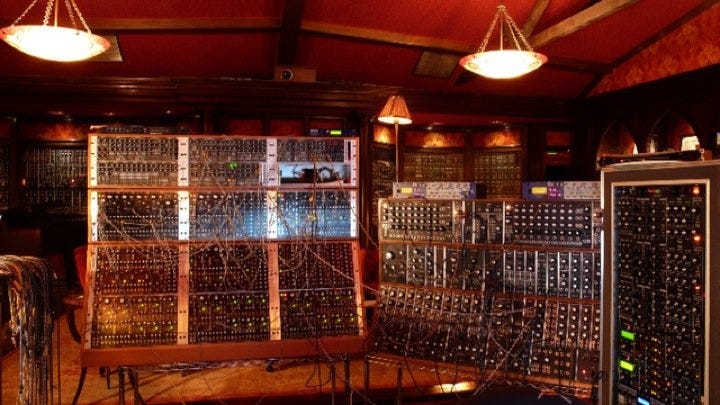
Very impressive! However this is not the kind of thing you would want to build for numerous reasons. I am not saying Herr Zimmer, has cocked it up and got it all wrong but…
He could have done this on an iPad!
Probably not because there are probably a lot of custom circuits in this setup asides the commercial offerings that you can buy from Signal Sounds for example.
So can you build modular synths on an iPad? Absolutely and the answer is MiRack which is very closely based on the desktop software VCV (which we shall cover another day).
Over the past few weeks I’ve been sharing notes on Substack featuring videos of the ideas I’ve been exploring with this product, such as:
I have decided to produce more tutorial based posts in which through a combination of text, audio examples and videos, walk you through how to set up some simple, to start with, building up to more advanced examples using both MiRack and VCV.
Here I go back to the project shared in the Note above and demonstrate the effects of each of the modules, explore what they are, what physical hardware modules they were based on because you could build a hardware version of this if you wanted to.
You can learn more about MiRack via the website
https://mirack.app/
It comes with more than 600 modules.
Coming up in future newsletters we shall look at how you can take a sample, perhaps recorded outdoors, a field recording of some kind, preferably quite a long one and feed that into MiRack via AUM as one method. There are of course sampler modules available for Eurorack, VCV and MiRack, all of which are based on the same standards.
Finally before we finish up, here are some recordings made using my hardware rack, driven by an Oxi One for sequencing. I recorded these with my Zoom L6, which incidentally I used for the walkthrough video above to channel my microphone into the recording, something I need to tweak a little bit more for better vocal clarity.
MiRack is such a powerful tool for exploring modular synthesis on iPad! The accessibility of this platform really democratizes what used to require thousands in hardware. Your experimental approach to patching is inspiring - it's clear you're pushing the boundaries of what's possible with iOS music production. Love seeing the creative process unfold.
I’ve done a few of my performances at MODCAF using mirack with an ES9 and AUM over the years